TL;DR
- Dobble’s one rule: any two cards share exactly one symbol.
- If you think of symbols as points and cards as lines, that rule becomes “any two lines meet in exactly one point”. Mathematicians call this a projective plane.
- With 8 symbols per card, simple counting forces the deck to have exactly 57 symbols and 57 cards. The box ships 55.
- You can build such a deck from a grid and some modular arithmetic, whenever the number of symbols per card minus one is a prime.
- Some deck sizes are impossible. One size, 13 symbols per card, is still an open problem.
I was playing Dobble with friends recently and couldn’t stop wondering how the deck is built. Every pair of cards matches on exactly one symbol, across 55 cards, and that doesn’t happen by accident. In this post we’ll start from nothing and build our way up to the full deck, one step at a time. You won’t need any math beyond counting and a bit of school algebra.
The Rule
A Dobble deck has 55 round cards with 8 symbols on each. You flip a card, compare it with yours, and race to spot the match. The whole game depends on one rule:
Any two cards share exactly one symbol.
Not zero, not two, exactly one. That’s what makes every round fair: there is always a match, and there is never more than one.
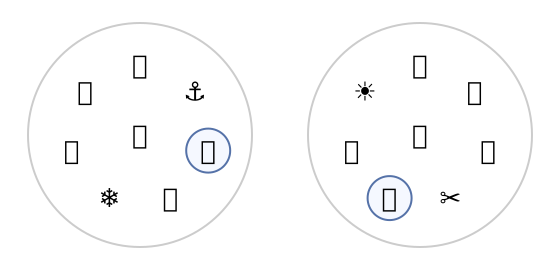
The idea is older than the game. In 1976, a French puzzle enthusiast named Jacques Cottereau made a set of 31 cards with 6 insect pictures each, where any two cards shared exactly one insect. Decades later, Denis Blanchot turned it into Dobble, released in 2009 and sold as Spot It! in the US [1]. Our goal is to understand how to design a deck like this, and why the numbers come out the way they do.
Before we get into the math, try the game yourself. Draw two cards and tap the symbol they share. Once you find it, the panel below the cards shows why that symbol is the match, by drawing both cards as lines on a grid. That picture won’t make sense yet, but by the end of the post it will.
The Cheat
There’s an easy way to satisfy the rule: put a star on every card, and fill the rest of each card with symbols that appear nowhere else. Any two cards now share exactly one symbol, the star, and you can make as many cards as you like. It follows the rule, but it ruins the game, because the answer is always the star.
So the rule alone isn’t enough, and we need to say what a fair deck looks like. A natural way is to ask that no pair of symbols is special either:
Any two symbols appear together on exactly one card.
With this second rule, every symbol has to pair up with every other symbol somewhere in the deck, and no single symbol can dominate. From here on, a “deck” means one that follows both rules.
Start Tiny: 2 Symbols per Card
Let’s build the smallest fair deck we can, with just 2 symbols per card. Start with one card, 🍎 ⚓. The apple and the anchor are now paired, so no other card can hold both of them. Add a third symbol, 🔥. It has to pair with the apple once and with the anchor once, which gives us two more cards: 🍎 🔥 and ⚓ 🔥.
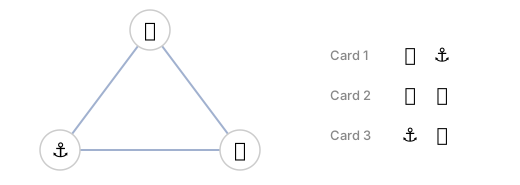
Both rules hold: any two cards share exactly one symbol, and any two symbols sit together on exactly one card. That’s a complete deck of 3 symbols and 3 cards. Look at the picture, though. Symbols are corners and cards are sides, and two sides of a triangle always meet at exactly one corner. Keep that in mind, because it’s going to come back.
One Step Up: 3 Symbols per Card
Now give each card 3 symbols. Working this out by hand takes a few minutes of crossing things out, but you’ll end up with exactly 7 symbols and 7 cards. Here’s one way to draw the result:
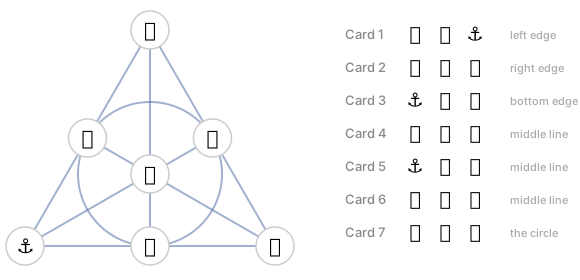
Each straight line through three symbols is a card, and so is the circle. Pick any two cards and they meet at exactly one symbol; pick any two symbols and exactly one line passes through both. This drawing is called the Fano plane, and once again symbols behave like points and cards behave like lines.
Cards Are Lines
Let’s make that idea official. Call each symbol a point and each card a line, so that a card “contains” a symbol in the same way a line passes through a point. Our two rules become:
- Any two lines meet in exactly one point.
- Any two points lie on exactly one line.
The second rule is ordinary geometry: through any two points you can draw exactly one line. The first is ordinary geometry too, with one exception. In the geometry we learn at school, parallel lines never meet, while the geometry of Dobble has no parallel lines at all.
A geometry like this is called a projective plane. The Fano plane is the smallest one (the triangle follows the same pattern, but mathematicians usually treat it as too small to count), and Dobble is a much bigger one. So the real question is: how big?
Counting: Why 57?
So far we have two data points. With 2 symbols per card we got 3 symbols in total, and with 3 symbols per card we got 7. Rather than guess the pattern, let’s derive it. To keep the formula tidy, say each card has n + 1 symbols, so n = 1 for the triangle, n = 2 for Fano, and n = 7 for Dobble.
First, how many cards does one symbol appear on? Pick any symbol, say the star, and a card X that doesn’t have the star. X has n + 1 symbols, and by the second rule each of them appears together with the star on exactly one card. Those cards are all different, because a card with the star can meet X at only one symbol. There are no other cards with the star either, because every card has to meet X somewhere. So the star appears on exactly n + 1 cards, and since nothing was special about the star, the same holds for every symbol.
Second, how many symbols are there in total? Look at the deck from the star’s point of view. It sits on n + 1 cards, and each of those cards has n other symbols. These symbols never repeat, because two cards that share the star can’t share anything else. And every symbol in the deck shows up on one of them, because every symbol pairs with the star somewhere.
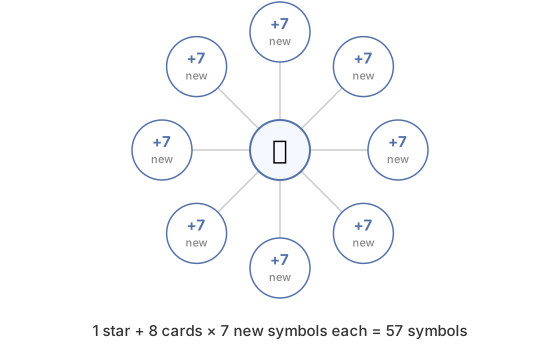
So the total is the star itself, plus n new symbols on each of its n + 1 cards:
1 + (n + 1) × n = n² + n + 1
It matches our small decks: n = 1 gives 3, and n = 2 gives 7. For Dobble, with 8 symbols per card, n = 7 and the deck has 49 + 7 + 1 = 57 symbols. Running the same argument with the words “card” and “symbol” swapped shows there are exactly 57 cards too. Nobody chose 57. Once you pick 8 symbols per card, the rules force it.
Where Did Two Cards Go?
The box says 55 cards, not 57. As far as I know the publisher has never explained why, and the usual guess is that 55 cards fit their printing sheets better. It doesn’t hurt the game, since taking cards out of a deck can’t break the rule that any two remaining cards share one symbol.
You can even work out which two cards are missing. In a full deck every symbol appears on 8 cards (that’s our first counting step, with n = 7). The two missing cards share one symbol, so in your box that symbol appears only 6 times, the other 14 symbols on the missing cards appear 7 times, and everything else appears 8 times. Count the symbols in your box and you can rebuild the lost cards.
Building a Deck
Knowing the size of a deck doesn’t tell us how to make one. For that we’ll go back to the picture we started with, real lines on a grid, and use n = 3 as the example (4 symbols per card, 13 cards).
- Lay out the points. Draw a 3 × 3 grid of dots. That’s 9 symbols.
- Draw the lines. Use lines of the form y = mx + b, with all arithmetic done modulo 3. “Modulo 3” means we only keep the remainder after dividing by 3, so a line that runs off the right edge wraps around to the left, like Pac-Man. Three slopes (0, 1, 2) with three offsets each, plus three vertical lines, gives 12 lines of 3 dots each.
- Fix the parallel lines. Two lines with different slopes meet at exactly one dot, but two lines with the same slope never meet, which breaks our rule. The fix is the same trick painters use for perspective: parallel lines meet “at infinity”. We give each slope its own extra symbol and add it to every line with that slope, so parallel lines now share exactly that symbol.
- Add the last card. The four extra symbols need a card of their own, so that any two of them appear together exactly once. That card is called the line at infinity.
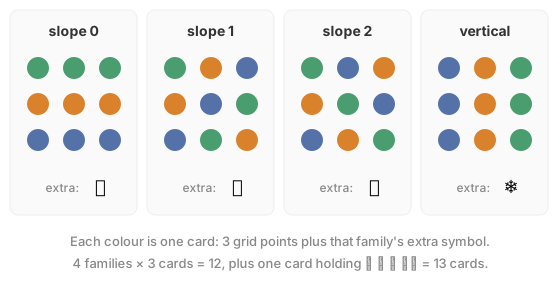
Now count. There are 12 + 1 = 13 cards and 9 + 4 = 13 symbols, with 3 dots plus 1 extra symbol on each card. That’s n² + n + 1 = 13, exactly what the counting argument predicted. If you scroll back up to the game and pick “4 per card”, the grid under the cards is exactly this construction, and you can watch any two of its lines meet.
Why n Has to Be Prime
Two lines y = m₁x + b₁ and y = m₂x + b₂ meet where x = (b₂ − b₁) ÷ (m₁ − m₂). That step divides, and division modulo n only works reliably when n is prime. Try n = 4: the lines y = 0 and y = 2x meet wherever 2x is a multiple of 4, which happens at both x = 0 and x = 2. Two lines meeting twice is exactly what we can’t allow.
Dobble uses n = 7, which is prime, so the recipe works. Here it is in Python, with a check over all 57 cards:
from itertools import combinations

def dobble_deck(n):
    """Build a deck for a prime n: n*n + n + 1 cards, n + 1 symbols per card."""
    cards = []
    # Slanted lines: y = m*x + b, plus the symbol for slope m
    for m in range(n):
        for b in range(n):
            cards.append([(x, (m * x + b) % n) for x in range(n)] + [f"slope {m}"])
    # Vertical lines: x = c, plus the symbol for "vertical"
    for c in range(n):
        cards.append([(c, y) for y in range(n)] + ["vertical"])
    # The line at infinity: every slope symbol together
    cards.append([f"slope {m}" for m in range(n)] + ["vertical"])
    return cards

deck = dobble_deck(7)
print(len(deck))  # 57
print(all(len(set(a) & set(b)) == 1 for a, b in combinations(deck, 2)))  # True
Swap the coordinates for pictures and you have Dobble.
Which Sizes Are Possible?
The grid recipe works whenever n is prime. A more general version, using structures called finite fields in place of plain remainders, also works when n is a power of a prime, like 4, 8 or 9. So you can build fair decks with 3, 4, 5, 6, 8, 9, 10 or 12 symbols per card.
Seven symbols per card, n = 6, is impossible, and the story goes back to Euler. In 1782 he asked whether 36 officers from 6 regiments and 6 ranks could stand in a 6 × 6 square with no regiment or rank repeated in any row or column. Gaston Tarry proved in 1901 that it can’t be done, and since a projective plane with n = 6 would give you such an arrangement, that plane can’t exist either [2]. In 1949, Bruck and Ryser found a more general rule that rules out many more sizes, including n = 14 and n = 21 [2]. Their rule says nothing about n = 10, which was settled only in 1989, when Clement Lam and his colleagues finished a computer search that took years: no plane with n = 10 exists [3].
Every projective plane anyone has ever found has a prime power for n, and nobody knows whether that’s always true. The smallest open case is n = 12, a Dobble deck with 13 symbols per card. We still don’t know if it can be built.
Wrapping Up
Here’s the path we took:
- Dobble’s rule is “any two cards share exactly one symbol”. To stop one symbol from taking over, we added “any two symbols appear together on exactly one card”.
- Small decks showed that symbols act like points and cards act like lines, in a geometry with no parallel lines.
- Counting from a single symbol’s point of view forced the size to be n² + n + 1, which is 57 for 8 symbols per card.
- A grid, modular arithmetic and one extra symbol per slope let us build the deck, as long as n is prime.
The game feels like it’s about fast eyes, but underneath it is a question Euler was already circling in the 1700s, and part of it is still open. Next time someone at the table asks why there are 55 cards, you can tell them the real number is 57.
References
[2] Wikipedia: Projective plane, finite projective planes
[3] C. W. H. Lam, “The Search for a Finite Projective Plane of Order 10”, The American Mathematical Monthly, 1991.